Signals without the full picture
A single measurement is difficult to interpret in isolation. Trends, personal baselines, recent activity, sleep, medications, and upcoming appointments can change the meaning of a signal.
Exploring how an AI health agent could connect signals, personal context, and explainable insights into a more proactive, human-centered healthcare experience.
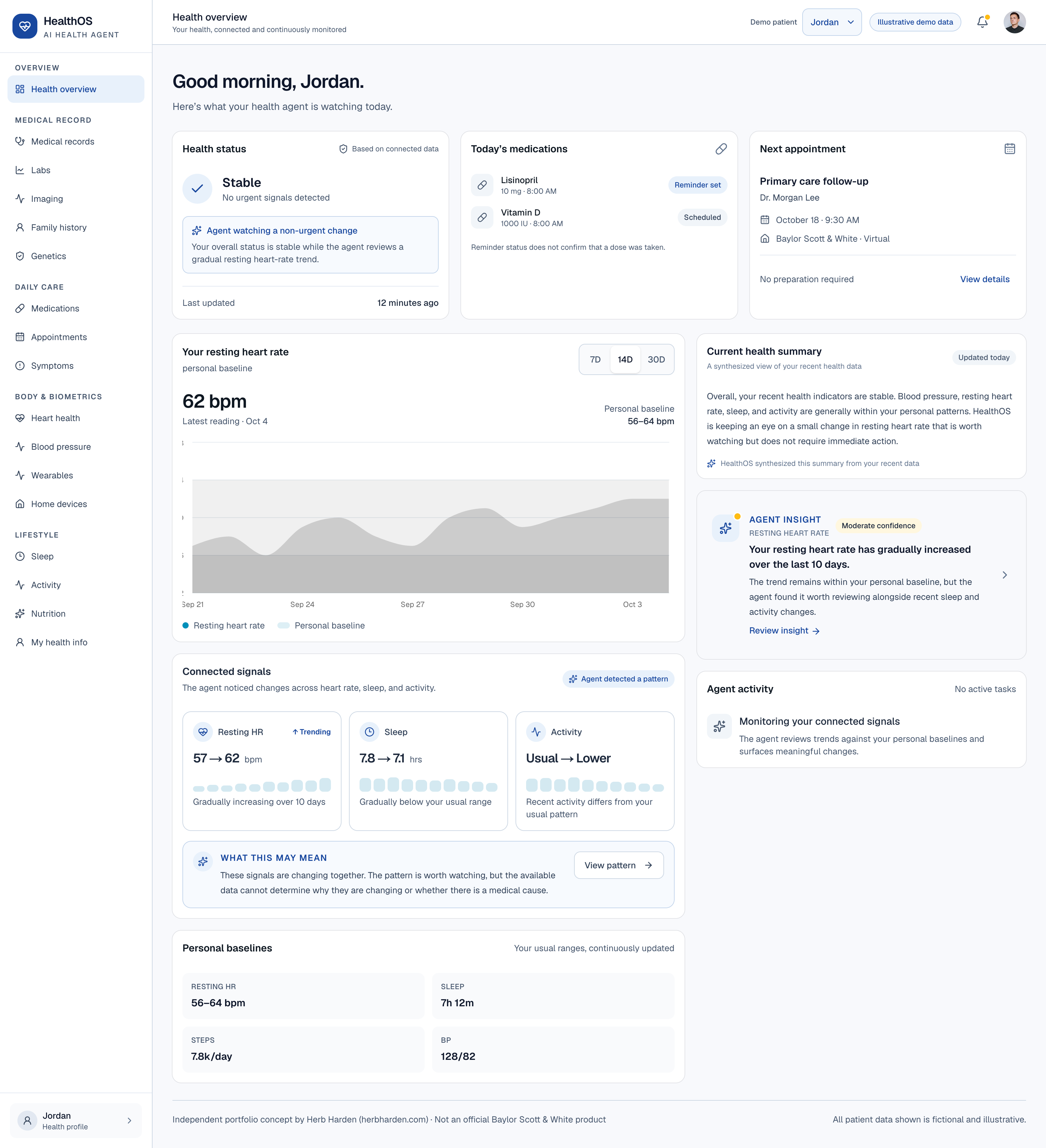
HealthOS explores a shift from passive health dashboards to a personalized health operating layer: an experience where an agent interprets changing signals in context, explains what it notices, and helps a person decide what to do next.
Rather than treating AI as a chatbot bolted onto a dashboard, the concept connects the agent to a shared patient state. The dashboard, insight cards, evidence, and conversation all reflect the same selected patient and the same underlying context.
The experience is organized around a simple principle: Observe → Understand → Explain → Act. The agent can surface a potential area of attention, make its reasoning visible, and present a possible next step while leaving review and approval with the person.
Design thesis: Trustworthy agentic healthcare is not just about producing an answer. It is about making the answer understandable, showing the evidence behind it, and preserving human agency over what happens next.
Personal health information can come from many places: wearable devices, measurements, medications, appointments, and clinical results. A collection of metrics may show what changed, but it does not necessarily help someone understand how those changes relate to their own baseline or what deserves attention.
A conversational assistant can answer questions, but a conversation alone may not provide a clear view of the underlying evidence, the patient context being considered, or the status of an action. A dashboard can display information, but it may leave the user to interpret the pieces themselves.
HealthOS investigates how these experiences could work together: a persistent view of the person’s health context, an agent that explains what it notices, and a transparent path from insight to action.
A single measurement is difficult to interpret in isolation. Trends, personal baselines, recent activity, sleep, medications, and upcoming appointments can change the meaning of a signal.
An agent needs to communicate what it noticed, what information informed its interpretation, where uncertainty remains, and which actions still require human review.
Identifying a potential concern is only part of the experience. People also need a comprehensible way to review options, approve an action, or continue monitoring.
The same interface must accommodate different health situations without forcing every person into the same priorities, data, or agent responses.
The central design decision was to treat patient context as shared state across the entire experience, rather than designing separate dashboards or independent conversations for each scenario.
A selectable patient context changes the information, metrics, agent insight, and relevant workflow together. This creates a consistent product model while allowing the experience to respond to different needs.
Experience model: Observe → Understand → Explain → Act. Each stage gives the user a clearer view of what the agent is doing and how to participate in the decision.
Bring together signals, trends, and personal baselines.
Interpret changes in the context of the selected patient.
Present the insight, supporting evidence, and uncertainty.
Let the person review, approve, or continue monitoring.
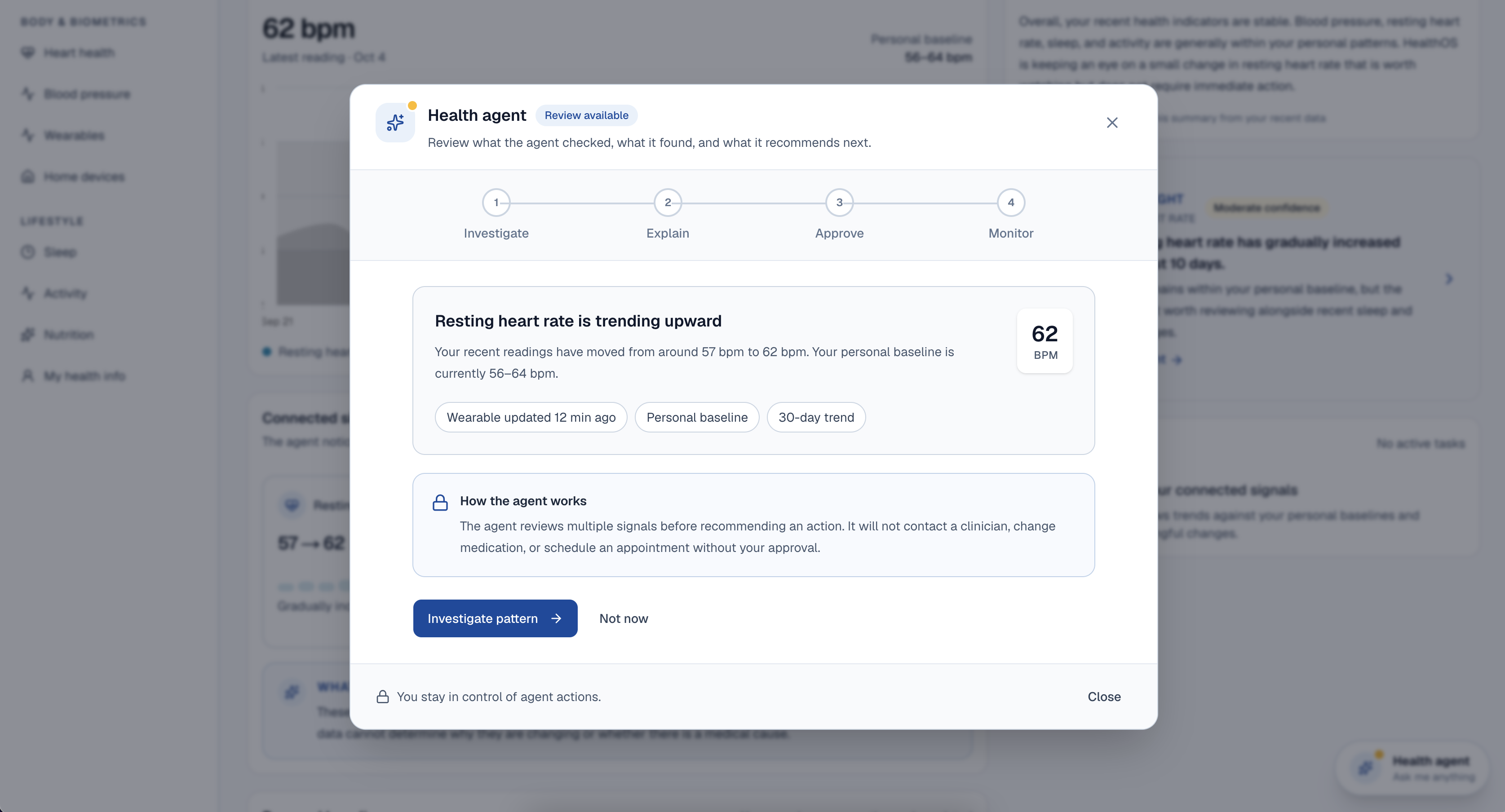
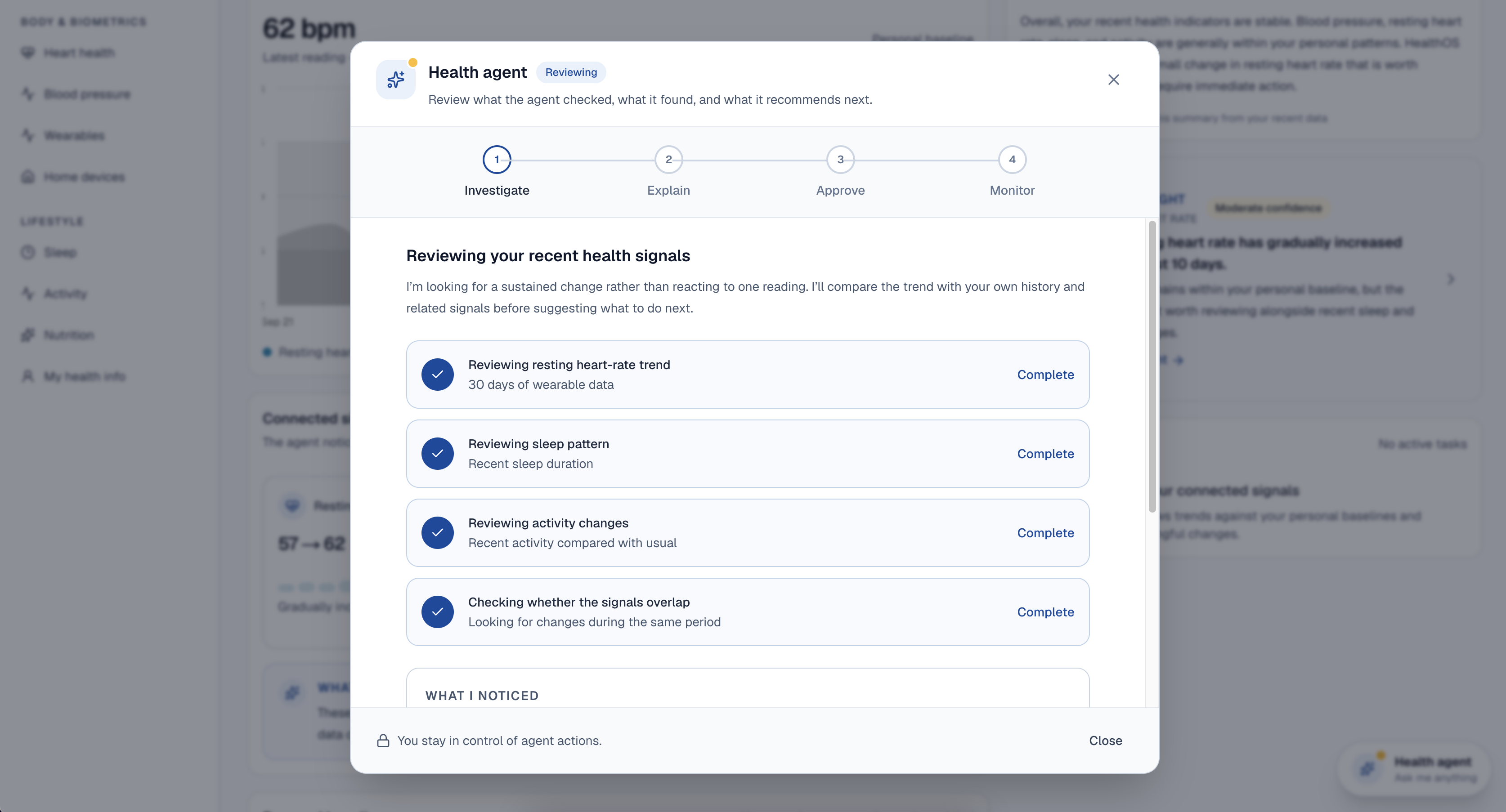
The dashboard acts as a window into the agent’s work. A dedicated agent insight surfaces the current area of attention, a patient-specific explanation, and a confidence indicator. The user can open the insight to explore the explanation and move through a simulated review workflow.
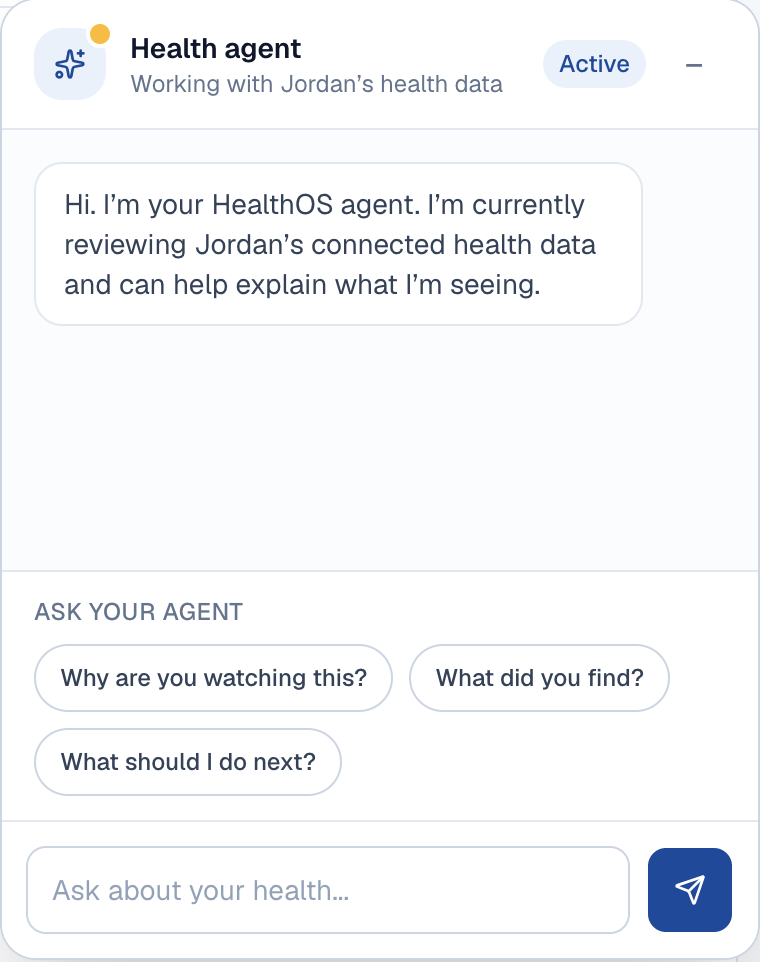
The conversational agent is designed as part of the product experience rather than a separate destination. Suggested prompts help users explore changes and results, while the conversation remains grounded in the currently selected patient’s illustrative data.
This relationship is important to the concept: the user can ask a question in natural language, but can also return to the dashboard to see the larger context around the response.
Three fictional patient scenarios make the shared-state concept tangible. Switching patients changes the dashboard’s content and the agent’s focus, illustrating how one product framework can adapt without becoming three disconnected experiences.

Resting heart rate rises from 57 to 62 over approximately 10 days alongside reduced sleep and activity. The scenario focuses on contextual interpretation without presenting the change as an urgent signal.

At pregnancy week 24, Maya’s context includes a prenatal appointment on Thursday, blood pressure in range, and prenatal vitamin adherence of 6 out of 7 days.

Alex’s type 2 diabetes scenario includes overnight glucose above baseline, time in range of 71%, and an A1c value of 7.1% to demonstrate a different pattern of agent attention.
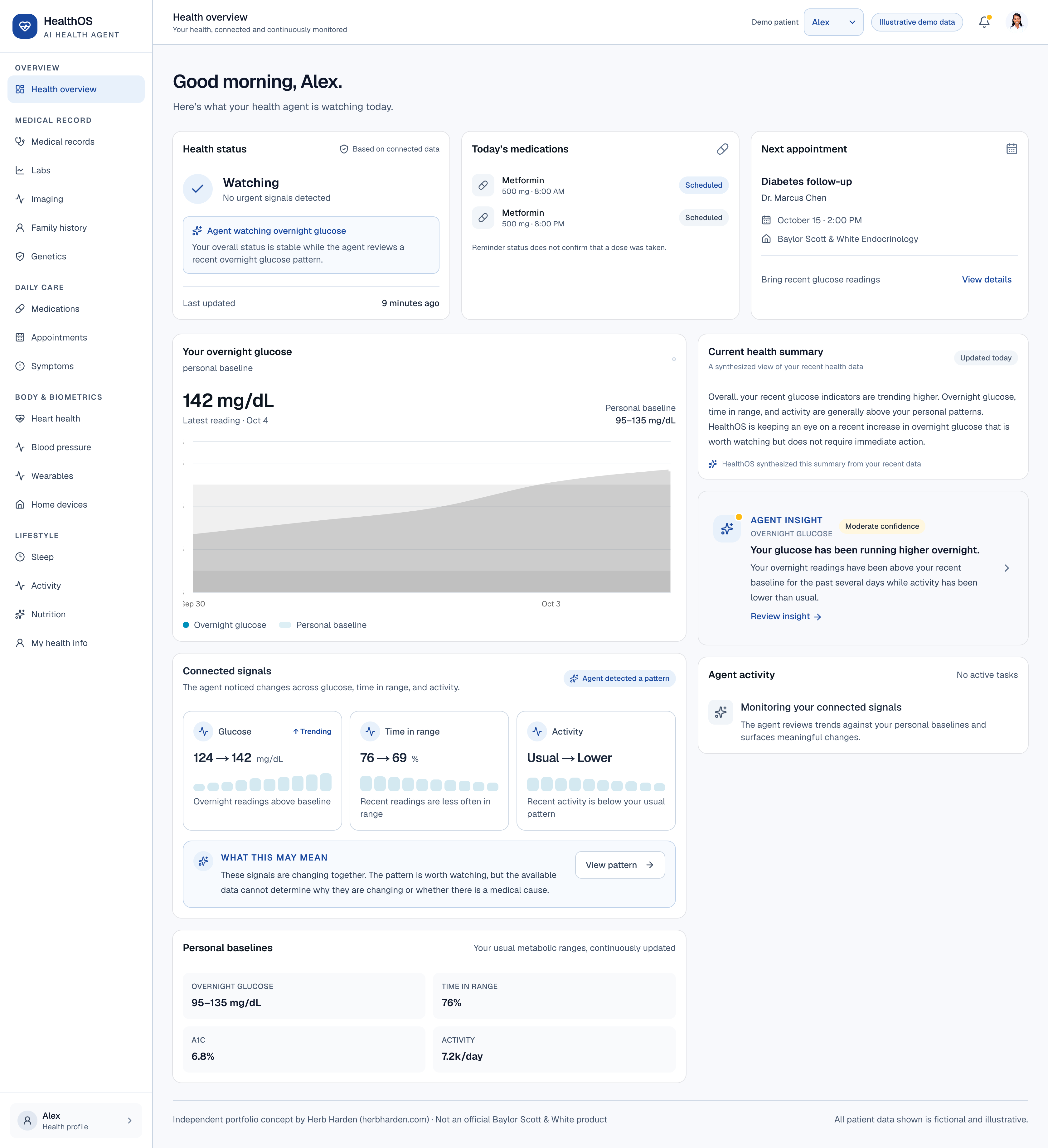
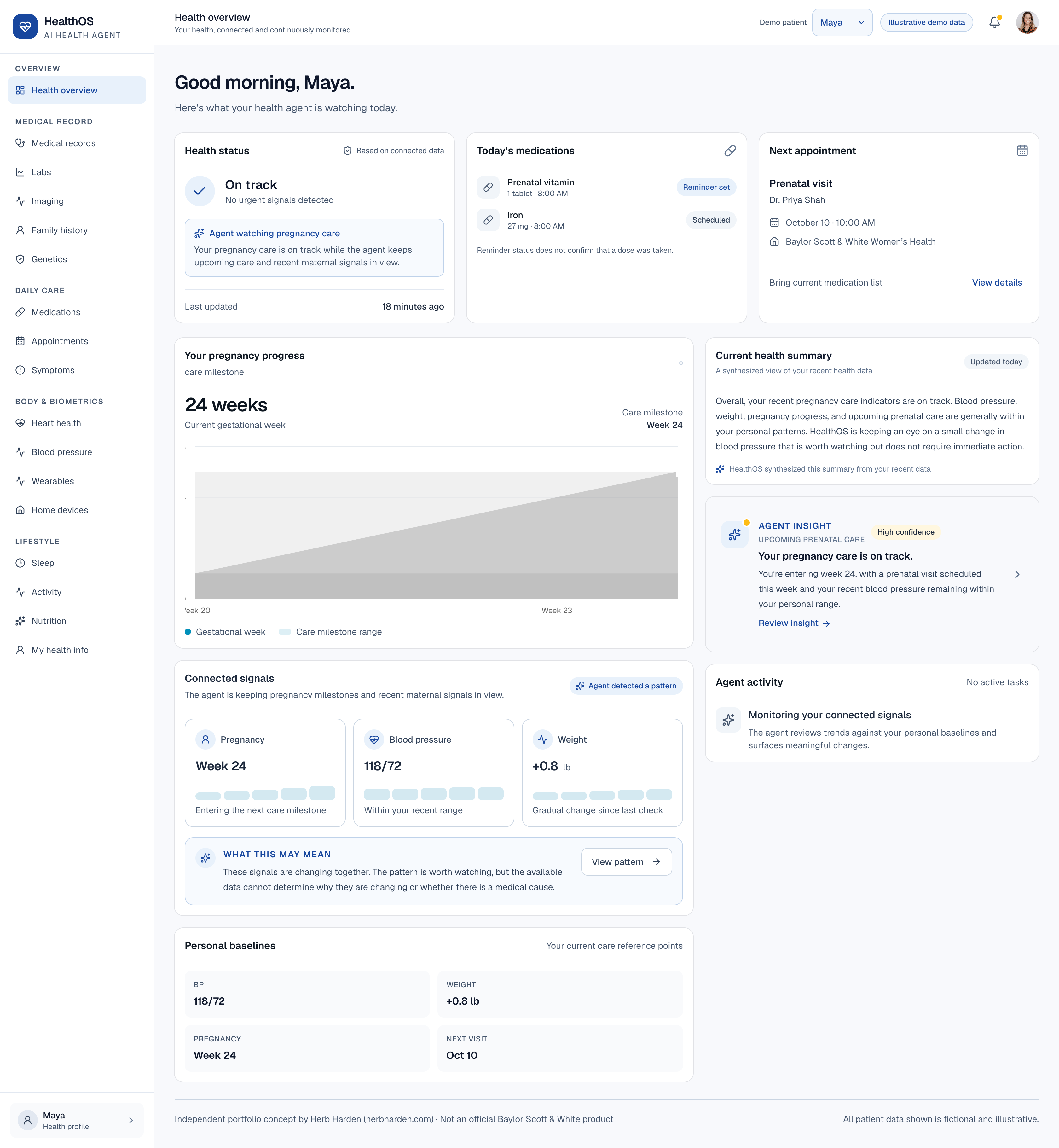
HealthOS was implemented as a front-end prototype to demonstrate the relationship between patient context, dashboard content, and an agent-guided workflow.
The prototype uses a shared patient data model for Jordan, Maya, and Alex. Patient selection updates the displayed information and the agent experience, making the underlying product behavior tangible rather than relying on static mockups alone.
Patient information follows a consistent schema, allowing the interface to render the appropriate metrics, signals, baselines, appointments, and agent insight for the selected scenario.
The prototype demonstrates investigation, explanation, evidence review, approval, and monitoring states through local interaction rather than a live AI service.
The interface combines structured health information with a conversational agent, keeping the broader patient context visible while the user explores an insight.
Built with Next.js, React, TypeScript, Tailwind CSS, shadcn/Base UI, Lucide React, and Recharts, using local state and illustrative data to power the experience.
The experience is intentionally a concept prototype, not a production healthcare application. It does not connect to an electronic health record, wearable device, real AI model, backend service, or scheduling system. Patient switching and agent workflow behavior are simulated with local data and state.
This scope made it possible to explore the product architecture and interaction model without suggesting that clinical intelligence, medical recommendations, or real-world actions had been validated.
The result is an interactive portfolio concept that demonstrates how a patient-aware agent could be integrated into a health dashboard through shared context, visible reasoning, and human-in-the-loop interaction.
Three fictional scenarios use a common product framework, demonstrating how patient switching can change dashboard content and agent behavior together.
Agent insights connect to an explanation and review workflow, making the path from a surfaced signal to a possible action visible.
The simulated chat experience is part of the broader dashboard rather than an isolated interface with no persistent context.
The concept is implemented in a working web interface, allowing the product structure and core interaction patterns to be explored directly.
The next phase would focus on evaluating whether people can understand an agent’s explanation, identify the evidence behind an insight, and maintain an appropriate sense of control over next steps.
I would test the experience with patients and clinicians, explore how confidence and uncertainty should be communicated, and define clinical, privacy, and safety guardrails before connecting the concept to real health data or actions.
Key takeaway: Designing an agentic product means designing more than a conversation. It means defining the shared context, visible reasoning, interaction states, and human decisions that make the agent understandable and useful.