1. Executive Summary
Platform overview and strategic design leadership
AssetGuardian AI represents a paradigm shift in industrial asset management, fusing high-throughput IoT telemetry streams with immersive WebGL 3D asset health viewports and intelligent automation guardrails. As a Staff Enterprise Product Designer, my mandate spanned orchestrating complex enterprise workflows across multi-node facilities, defining scalable design system architectures, and establishing human-AI interaction patterns that mitigate automation bias in high-stakes operational environments.
By aligning product strategy with deep reliability engineering constraints, we transformed siloed diagnostic processes into an intuitive, proactive command center. The result significantly compresses triage cycles, eliminates false-positive alert fatigue, and protects multi-million-dollar physical infrastructure through transparent, verifiable AI governance.
2. The Challenge
Operational bottlenecks and enterprise UI friction
Heavy machinery like gas turbine compressors and industrial generators experience micro-vibrations that precede component wear. Maintenance teams miss early degradation signals when parsing siloed CSV logs or manual inspection schedules.
Enterprise operators faced acute UI complexity and interaction friction when navigating dense facility architectures under extreme time constraints:
Siloed Data
Data was trapped across disconnected legacy tools, requiring manual cross-referencing to diagnose equipment stress.
Severe Alert Fatigue
Platforms generated overwhelming false-positive alarms daily, obscuring true degradation warnings.
Context Switching Overhead
Operators had to constantly pivot between disparate monitoring tools, buried directory hierarchies, and legacy manuals during active failure responses.
3. The Solution and Execution
Staff-level design architecture, unified telemetry systems, and AI governance
As a staff enterprise product designer, my approach centered on translating complex algorithmic outputs into intuitive, high-velocity decision workflows. Rather than simply skinning raw telemetry feeds, I architected a holistic design system framework that bridges real-time IoT event streams with spatial 3D visualization. By establishing rigorous human-AI interaction contracts, setting up predictable component scaling guidelines, and partnering closely with engineering stakeholders, we delivered a resilient command architecture that empowers operators to act with absolute confidence during critical facility events.
Spatial Priority Grid & WebGL Viewports
Pinned high-priority assets front-and-center, paired directly with live Three.js 3D models featuring pulsing anomaly hotspots for rapid visual root-cause identification.
Industrial Design Tokens
Adapted official GE Vernova brand guidelines into robust design tokens, utilizing deep industrial teals for structural frames alongside high-contrast warning colors.
AI Governance & Safety Interlocks
Engineered transparent probabilistic confidence scores and two-step verification modals requiring manual validation before triggering safety interlocks on physical hardware.
3D Asset Diagnostics & Spatial Layout View
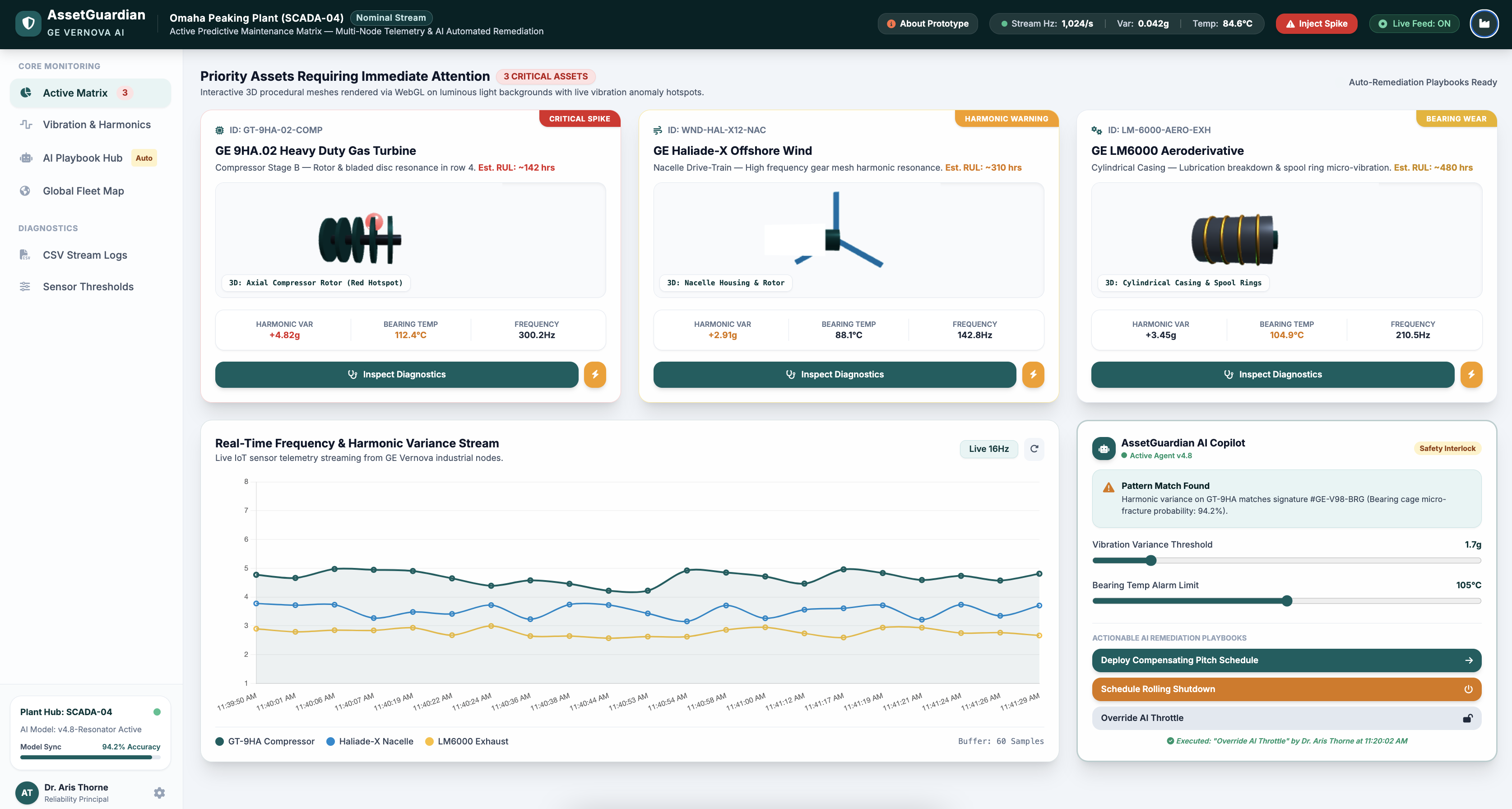
Facility Node & AI Remediation Controls
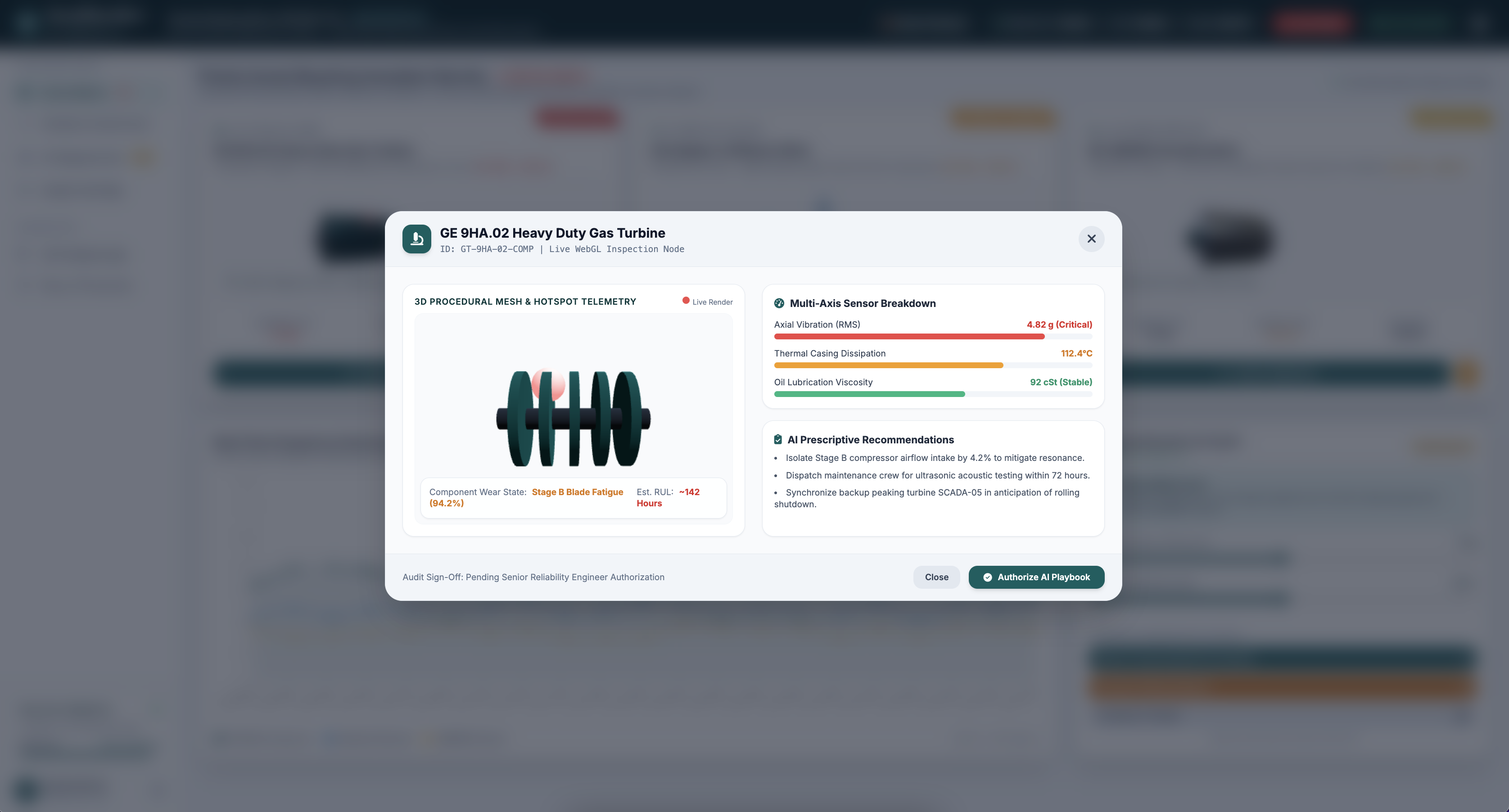
4. Targeted Business Impact
Downtime mitigation, operational efficiency, and ROI
Reduction in Alert Triage Time
Drastically streamlines telemetry parsing and anomaly root-cause isolation down to seconds through intelligent pattern matching.
Decrease in Unplanned Downtime
Accurately estimates Remaining Useful Life (RUL) hours well in advance of structural component fatigue across multi-node facilities.
Capital Asset Protection
Prevents multi-million-dollar secondary damage by automatically engaging safety interlocks upon detecting out-of-spec harmonic variances.
Alert Fatigue Eradication
Filters out false-positive background vibration noise, ensuring operators only intercept high-severity structural anomalies.